What Is Stochasticity? A Plain-English Explanation
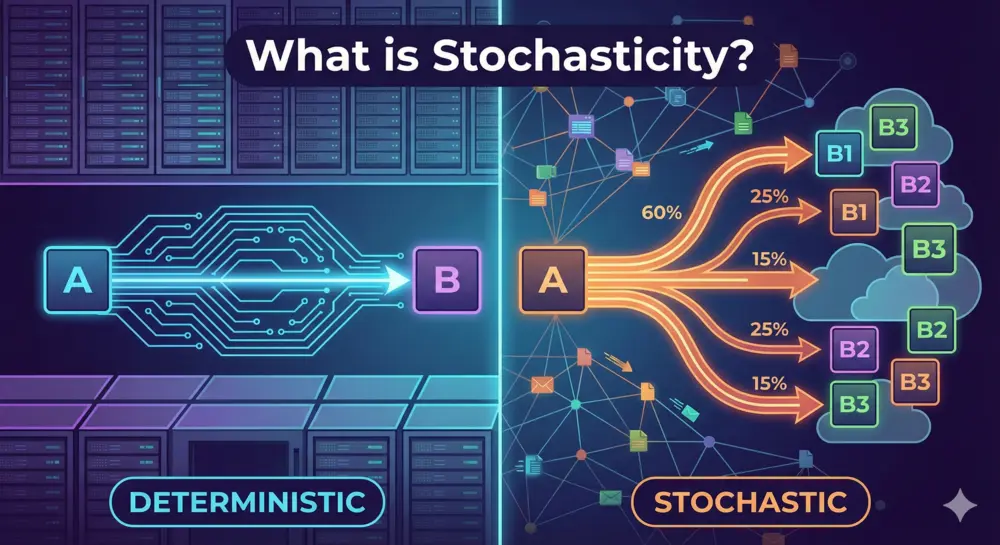
In the world of software engineering, automation, and security, we often strive for determinism. We want to know that if we input “A,” we will always get “B.” However, the real world—and complex computing environments—rarely plays by those rules. This is where stochasticity comes in.
Defining the Term
At its core, stochasticity refers to the quality of being determined by a random probability distribution. While a “deterministic” system will always produce the same output from a given starting condition, a “stochastic” system involves an element of chance.1
You can think of it as “controlled randomness.” It isn’t total chaos; rather, it is a process where the next state of the environment is partially determined by the previous state and partially by a random variable.
Stochastic vs. Random: What’s the Difference?
While people often use these terms interchangeably, there is a subtle distinction:
-
Randomness: Usually refers to a lack of pattern or predictability (like a single coin flip).2
-
Stochasticity: Refers to a process or system that evolves over time involving random variables. It’s about the sequence and the probabilities governing that sequence.
Why It Matters for Technical Professionals
As you move from a beginner to a mid-level professional, understanding stochasticity helps you build more resilient systems. Here are three areas where it shows up:
-
Load Testing & Performance: Traffic hits a server stochastically. Users don’t arrive in perfect 1-second intervals; they arrive in clusters. Understanding this helps you model realistic stress tests.
-
Artificial Intelligence: Modern AI and Machine Learning models are inherently stochastic. They don’t just “calculate” an answer; they predict the most probable outcome based on massive datasets.
-
Cybersecurity: In security, we use stochastic processes to model threat actor behavior or to generate cryptographic keys that are unpredictable enough to resist brute-force attacks.3
Embracing the Uncertainty
For many engineers, stochasticity feels like a “bug.” We call it flakiness in automated tests or jitter in network latency. But once you stop fighting it and start modeling it, you can build better software.
Instead of asking, “Why didn’t this happen exactly the same way?” we begin to ask, “What is the probability of this failing, and how do we handle that margin of error?”
References
[1] https://www.symphonyai.com/glossary/ai/deterministic-model/
If you found this post helpful, consider buying me a coffee. It keeps me writing!
