CVE-2026-31431: Copy Fail — A Decade-Old Linux Kernel Privilege Escalation
Table of Contents
Summary
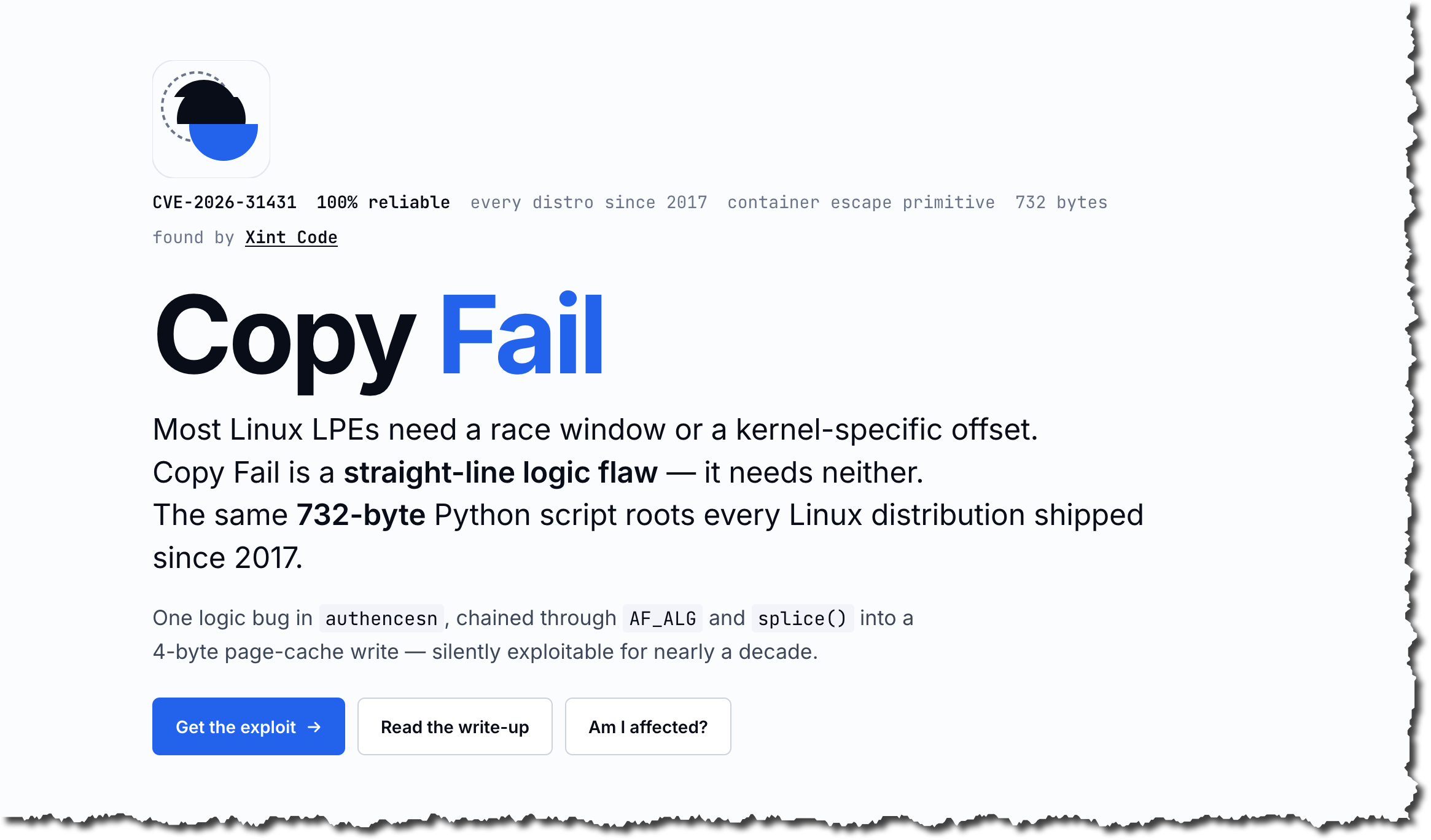
CVE-2026-31431, nicknamed Copy Fail, is a critical local privilege escalation (LPE) vulnerability in the Linux kernel that has been silently exploitable since 2017. It requires no race conditions, no kernel-specific offsets, and no special privileges — just a local user account and a 732-byte Python script.
The flaw lives at the intersection of three kernel subsystems: the AF_ALG crypto socket interface, the splice() system call, and the authencesn AEAD algorithm template. When combined, they allow an unprivileged user to write 4 controlled bytes into the page cache of any readable file on the system — including setuid binaries like /usr/bin/su.
| Detail | Value |
|---|---|
| CVE ID | CVE-2026-31431 |
| Vulnerability | Local Privilege Escalation (LPE) |
| Severity | Critical |
| Affected Systems | All mainstream Linux distros built between 2017 and patch date |
| Exploit Size | 732 bytes (Python 3.10+, stdlib only) |
| Reliability | 100% — no races, no offsets, deterministic |
| Patch Commit | a664bf3d603d |
| Discovered by | Taeyang Lee (via Xint Code) |
How the Vulnerability Works
Copy Fail is a logic flaw, not a memory corruption bug. It emerges from three independent design decisions that were never audited together.
The Three Components
1. authencesn AEAD template (added 2011)
The authencesn algorithm handles AEAD (Authenticated Encryption with Associated Data) with Extended Sequence Numbers. During decryption, it rearranges sequence number bytes by writing 4 bytes of scratch data at offset assoclen + cryptlen of the destination scatterlist. This was safe in 2011 because AF_ALG used separate, isolated buffers.
2. AF_ALG AEAD support (added 2015)
AF_ALG is a kernel interface that exposes the in-kernel cryptographic subsystem to unprivileged userspace. When AEAD support was added in 2015, it initially operated out-of-place, meaning input and output buffers were separate.
3. In-place optimization via splice() (added 2017)
In 2017, an optimization was introduced: if a user calls splice() to feed page cache pages as ciphertext, those same pages are chained directly into the writable destination scatterlist via sg_chain(). This avoids a copy but means page cache pages of real files become writable destinations.
The Bug at the Intersection
When these three pieces combine:
authencesnwrites its 4-byte scratch value into what it believes is the output buffer- But the output buffer now contains page cache pages of a real file (fed via
splice()) - The 4-byte overwrite lands in the page cache of that file — not on disk, not marked dirty
- The write is controlled: the attacker chooses the target file, the offset, and the written value via crafted AAD
The corrupted page is never written back to disk. On-disk checksums remain valid. File integrity monitoring tools see nothing. But the kernel’s in-memory view of the file is modified.
Exploitation Path
The exploit targets setuid binaries (default: /usr/bin/su):
1. Open AF_ALG socket; bind to authencesn(hmac(sha256),cbc(aes))
2. Craft sendmsg() AAD with target write value in seqno_lo bytes
3. Use splice() to chain target file's page cache as ciphertext
4. Trigger recv() — authencesn writes 4 bytes into page cache
5. HMAC verification fails (expected), but the corruption persists
6. execve() loads the corrupted setuid binary from page cache → root
The entire exploit fits in 732 bytes of pure Python using only os, socket, and zlib from the standard library.
Affected Systems
The vulnerability was introduced by a 2017 kernel commit. Every mainstream Linux distribution built after that point and before the patch is affected.
Confirmed vulnerable:
| Distribution | Kernel Version |
|---|---|
| Ubuntu 24.04 LTS | 6.17.0-1007-aws |
| Amazon Linux 2023 | 6.18.8-9.213.amzn2023 |
| RHEL 10.1 | 6.12.0-124.45.1.el10_1 |
| SUSE 16 | 6.12.0-160000.9-default |
Likely also affected: Debian, Arch, Fedora, Rocky, Alma, Oracle, and any other distribution running a kernel from the 2017–2026 window.
Why This Is Particularly Dangerous
Most LPEs require at least one of: a narrow race window, kernel-specific hardcoded offsets, or pre-installed exploit primitives. Copy Fail needs none of these.
The same 732-byte script runs unmodified across all affected distributions.
Beyond single-machine compromise, the implications are severe for shared environments:
- Multi-tenant Linux systems: Any user becomes root
- Kubernetes / containers: The Linux page cache is shared across container boundaries. A compromised container can corrupt files visible to other containers on the same node — this is a container escape primitive
- CI/CD systems: Untrusted pull request code runs in builds; LPE means full host compromise
- Cloud SaaS: A tenant user can achieve host-level root on the underlying VM
Additionally, because the corruption lives only in the page cache (never flushed to disk), the attack is evasion-friendly: file integrity monitoring, IDS tools, and disk-based forensics will not detect it.
Root Cause: Nobody Connected the Dots
The vulnerability is best understood as a latent bug created by three engineering teams, years apart, each making individually reasonable decisions:
“Nobody connected the 2017 in-place optimization to authencesn’s scratch writes or to the splice path’s use of page cache pages.”
This is a textbook example of an emergent vulnerability — safe components that become dangerous at their intersection. The kernel cryptographic API, the splice zero-copy path, and the AEAD algorithm template each work correctly in isolation.
Patch and Mitigations
Kernel Fix
Mainline commit a664bf3d603d reverts algif_aead.c to out-of-place operation. The fix separates req->src (TX scatterlist) from req->dst (RX buffer), ensuring that page cache pages fed via splice() are never placed into a writable scatterlist. The 2017 optimization is removed.
Interim Mitigations (if patching immediately is not possible)
Option 1 — Disable the algif_aead kernel module:
echo "install algif_aead /bin/false" | sudo tee /etc/modprobe.d/disable-algif-aead.conf
sudo modprobe -r algif_aead 2>/dev/null || true
Option 2 — Block AF_ALG via seccomp (for container workloads):
Add a seccomp profile that denies socket(AF_ALG, ...) calls. This prevents the exploit from initializing the crypto socket.
Check if your system is currently exposed:
# Check if algif_aead module is loaded
lsmod | grep algif_aead

# Check kernel version (vulnerable if between 2017 and patch date)
uname -r
Disclosure Timeline
| Date | Event |
|---|---|
| March 23, 2026 | Initial report sent to Linux kernel security team |
| March 24, 2026 | Acknowledgment received |
| March 25, 2026 | Patches proposed and reviewed |
| April 1, 2026 | Patch committed to mainline (a664bf3d603d) |
| April 22, 2026 | CVE-2026-31431 assigned |
| April 29, 2026 | Public disclosure |
Discovery
The vulnerability was discovered by Taeyang Lee using Xint Code, an AI-assisted security analysis tool. Lee identified AF_ALG + splice() as a high-risk attack surface and used Xint Code to scan the crypto subsystem with specific context about page cache provenance. The tool flagged Copy Fail as the highest severity finding within approximately one hour.
Conclusion
Copy Fail (CVE-2026-31431) is a critical privilege escalation vulnerability that silently affected nearly a decade’s worth of Linux kernel releases. Its combination of reliability, portability, and stealth makes it exceptionally dangerous — particularly in multi-tenant cloud and Kubernetes environments.
If you run Linux, patch now. Apply kernel commit a664bf3d603d or use your distribution’s security update channel. If patching is delayed, disable algif_aead immediately.
References:
- copy.fail — Official vulnerability disclosure
- Xint.io write-up — Technical analysis and affected distributions
- Kernel patch: commit
a664bf3d603d
If you found this post helpful, consider buying me a coffee. It keeps me writing!
