
AI Writes the Code Now. What Happens To QA?
Table of Contents
AI can write a working feature in minutes. A team that once needed a sprint now needs an afternoon. The coding bottleneck — the thing that has defined the pace of software development for decades — is effectively gone.
But a new one has taken its place.
The question nobody is asking loudly enough: who validates all of this code?
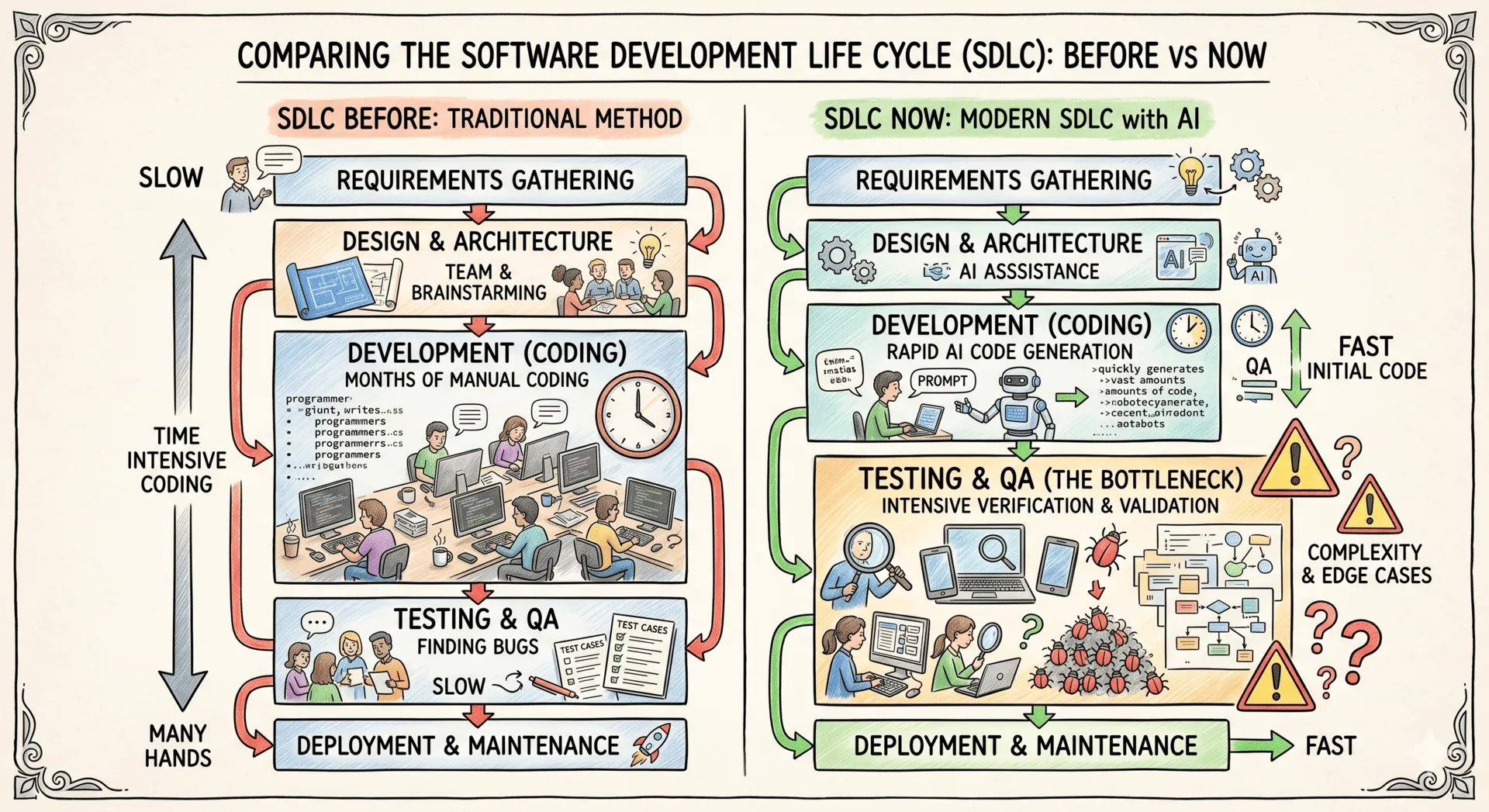
Testing Is the New Bottleneck
For decades, the slowest part of software development was writing the code. It required skilled engineers, careful architecture decisions, and weeks of careful implementation. That was always the expensive part — the thing you had to budget time and people for.
AI has dissolved that bottleneck almost completely. Describe a feature, and a capable AI agent can scaffold it, wire it up, and run it in minutes. The hard part is no longer building — it is verifying.
Writing the code is no longer the problem. Validating that the code is correct — that it does what it should, doesn’t break what already works, and holds up under real user behavior — that is now the slowest step in the chain.
The Speed Problem
The software development lifecycle is changing faster than most organizations are prepared for. Features that used to take a sprint can now ship in hours. The pipeline has accelerated dramatically at the top, but the testing layer has not caught up.
Manual regression testing was already a pain point before AI. Running a full test suite by hand every sprint required dedicated time, discipline, and a good memory for every edge case. Now it is simply not an option at all.
If your delivery speed has multiplied by ten but your testing speed has stayed the same, you have a bottleneck. And eventually, that bottleneck becomes a production incident.
What This Means for QA Engineers
The easy answer is: not much, keep doing what you are doing. But that is wrong.
Manually clicking through an application to find bugs does not scale to the speed at which AI-assisted teams can ship. Neither does having a solid understanding of test automation frameworks if you are still hand-writing every test yourself.
The skill that actually matters now is using AI as a multiplier for what you already know. Whatever you do well in your current role — exploratory testing, regression coverage, edge case thinking — an agent built with your instructions can do it faster and at greater volume.
The New Role: Coding Agent Manager
You still need to understand Playwright or Cypress deeply. That knowledge is not optional — you cannot review what you do not understand. But you are no longer the person who writes every selector, every assertion, every page object from scratch.
Your job is to set the task, review the output, refine the agent’s instructions, and validate the result. Agents can handle roughly 90% of the mechanical work of writing test automation. Your human expertise fills the last 10% — the judgment calls, the subtle edge cases, the things that require real domain knowledge.
Think of it like the shift from craftsman to engineering director. You have moved up the abstraction layer. You are no longer writing tests; you are designing the system that produces them. Instead of spending hours perfecting page object design, you spend that time refining agent instructions so it can do the job autonomously with the highest success rate possible.
History Says QA Is Not Going Anywhere — It Is Growing
There is a 19th-century economic principle called the Jevons Paradox: when you make something more efficient, total consumption of it usually goes up, not down. More efficiency creates more demand, not less.
This pattern plays out across technology history. Between 1980 and 2010, around 400,000 ATMs were installed across the United States. Bank tellers feared their jobs were finished. Instead, bank teller employment grew from 500,000 to 600,000 over that same period.
In 2016, Geoffrey Hinton — computer scientist and Turing Award winner — declared that people should stop training radiologists. AI was performing image recognition better than humans in some benchmarks. By 2025, American diagnostic radiology residency programs offered a record 1,208 positions across all specialties, a four percent increase from 2024.
As software development becomes cheaper and faster, more software gets built — in healthcare, logistics, education, everyday devices. All of it needs to be tested. The total demand for QA does not shrink. It expands.
Stay Open, Stay Relevant
The QA role is not going away. But the version of it that exists today is not the version that will exist in two years. The shape of the work is changing fast.
The engineers who will be in highest demand are those who can manage AI agents, review test output with critical eyes, and refine automation systems at scale. Titles and job descriptions will follow, but the underlying capability is what matters.
If you are interviewing for a QA role today, the question worth preparing for is not “how many test cases have you written?” It is “what agents will you build and how will they work?” That answer is what separates candidates who understand where the field is going from those still focused on where it has been.
Working with agents is not as difficult as it sounds — and honestly, it is a lot of fun. Your expertise does not become obsolete; it becomes the instruction set for a much faster version of you. The transformation is happening either way. The only question is whether you are in front of it or behind it.
If you found this post helpful, consider buying me a coffee. It keeps me writing!
